Showing posts with label The System: Expanded. Show all posts

Monday, November 6, 2017

The System Surpasses 10,000 Downloads!!!

So it seems that while I've been asses and elbows over the last few months with real-world client work, PDF downloads of my generic RPG The System surpassed 10,000 total downloads! The System is the universal RPG that I originally wrote as a high-schooler in 1985, abandoned when I realized GURPS had hit the market, then finally resurrected when I discovered the OSR back in the early part of 2011 (though had yet to understand what a retro-clone was... which The System is definitely not).

As a published RPG product, it predates the other things for which I'm known (including the d30 DM Companion, the otherwise first of my published products). It has been available as a free PDF download (direct from this link) and in print-on-demand from Lulu.com.

If you've never heard of The System, here's the topline overview... I originally wrote/designed this in late 1985/early 1986 (when I was about 16 years old) before other universal role playing systems were available on the market. As I was getting ready to playtest it with my friends, a guy in our gaming group brought in a copy of the (then) newly-released GURPS, and I shelved my system in the disappointment that comes with having someone beat you to the punch. In 2011, I "rescued the from oblivion" (that is, I scanned the old daisy-wheel printed version that came from my dad's word processor at work), gave it a (very) quick polish to the ruleset, and typeset it with a decidedly retro (1st generation) RPG feel to it.

As stated previously, I'm quite willing to admit the game has its flaws... I mean, c'mon, I was 16 or so when I wrote it. (e.g., there is a very convoluted constitution-to-hit-point system, and there is an innovative but ultimately ill-conceived initiative and movement tracking system, and while it purports to handle supers among its genres, I can't claim that it actually scales to reflect the expanse of power levels between the weakest and strongest heroes). But over time, I have more and more appreciation for the fact that it uses d6s only, and led to some underlying things that Welbo and I would like to see become part of a "2nd Edition" of The System. (Should we ever get back to it, but may something it takes us 10 or more years to complete.)

• If you want the full story on The System, check out this post.
• To download a free PDF from MediaFire, click here.
• To buy a deeply-discounted print copy of The System from Lulu.com, head over here.

Thursday, July 7, 2016

The System Surpasses 9,000 Downloads

It seems like the only time I mention The System on this blog is when it hits another download milestone (which is because the only time I mention The System on this blog is when it hits another download milestone). The System is the universal RPG that I originally wrote as a high-schooler in 1985, abandoned when I realized GURPS had hit the market, then finally resurrected when I discovered the OSR back in the early part of 2011 (though had yet to understand what a retro-clone was... which The System is definitely not).

As a published RPG product, it predates the other things for which I'm known (including the d30 DM Companion, the otherwise first of my published products). It has been available as a free PDF download (direct from this link) and in print-on-demand from Lulu.com.

Well... some time over the last few days, the free downloads of The System from my MediaFire link surpassed the 9,000 mark (which does not include downloads from co-located downloads, like the one at 1KM1KT).

If you've never heard of The System, here's the topline overview... I originally wrote/designed this in late 1985/early 1986 (when I was about 16 years old) before other universal role playing systems were available on the market. As I was getting ready to playtest it with my friends, a guy in our gaming group brought in a copy of the (then) newly-released GURPS, and I shelved my system in the disappointment that comes with having someone beat you to the punch. In 2011, I "rescued the from oblivion" (that is, I scanned the old daisy-wheel printed version that came from my dad's word processor at work), gave it a (very) quick polish to the ruleset, and typeset it with a decidedly retro (1st generation) RPG feel to it.

As stated previously, I'm quite willing to admit the game has its flaws... I mean, c'mon, I was 16 or so when I wrote it. (e.g., there is a very convoluted constitution-to-hit-point system, and there is an innovative but ultimately ill-conceived initiative and movement tracking system, and while it purports to handle supers among its genres, I can't claim that it actually scales to reflect the expanse of power levels between the weakest and strongest heroes). But over time, I have more and more appreciation for the fact that it uses d6s only, and led to some underlying things that Welbo and I would like to see become part of a "2nd Edition" of The System. (Should we ever get back to it, but may something it takes us 10 or more years to complete.)

• If you want the full story on The System, check out this post.
• To download a free PDF from MediaFire, click here.
• To buy a just-over-cost print copy of The System from Lulu (for $3.95), head over here.

Sunday, June 28, 2015

The System Surpasses 8,000 Downloads

It's been a while since I mentioned The System around these parts. The System is the universal RPG that I originally wrote as a high-schooler in 1985, abandoned when I realized GURPS had hit the market, then finally resurrected when I discovered the OSR back in the early part of 2011 (though had yet to understand what a retro-clone was... which The System is definitely not).

Some time on this Friday just passed, the free downloads of The System from my MediaFire link surpassed the 8,000 mark (which does not include downloads from co-located downloads, like the one at 1KM1KT).

If you've never heard of The System, it was actually the first New Big Dragon RPG product ever published (in the early months of 2011), and the one that set the ball in motion for what I've done since. Below is how the "original edition" appeared in the mid 80s (on the left) and how it appears now in the "25th Anniversary Edition" (on the right).


I'm quite willing to admit the game has its flaws... I mean, c'mon, I was 16 or 17 when I wrote it. (e.g., there is a very convoluted constitution-to-hit-point system, and there is an innovative but ultimately ill-conceived initiative and movement tracking system, and while it purports to handle supers among its genres, I can't claim that it actually scales to reflect the expanse of power levels between the weakest and strongest heroes). But over time, I have more and more appreciation for the fact that it uses d6s only, and led to some underlying things that Welbo and I would like to see become part of a "2nd Edition" of The System. (Should we ever get back to it.)

There have been some interesting developments over the last four years or so. For example, it was poised to become a guy in Brazil's replacement for GURPS. I've also received several emails over the years with people asking about using the underlying system as a framework for other games (both tabletop and computer-based), though nothing has ever materialized from those inquiries.

• If you want the full story on The System, check out this post.
• To download a free PDF from MediaFire, click here.
• To buy a print copy of The System from Lulu, head over here.

Wednesday, July 2, 2014

The System Hits 7,000 downloads!!!!!!!

If you've followed this blog for longer than a year or so have heard me mention The System, the universal RPG that I originally wrote as a high-schooler in 1985, abandoned when I realized GURPS had hit the market, then finally resurrected when I discovered the OSR, but a year or so before I became part of the OSR blogosphere proper.

Long story short, it's just hit 7,000 downloads from MediaFire (which does not include downloads from 1KM1KT). So you don't have to search through that site, download links can be found at the New Big Dragon web site.

If you've never heard of The System, the original story is here. It was actually the first New Big Dragon RPG product ever published (in the early months of 2011), and the one that set the ball in motion for what I've done since. I'm quite willing to admit the game has its flaws... I mean, c'mon, I was 16 or 17 when I wrote it. (e.g., there is a very convoluted constitution-to-hit-point system, and there is an innovative but ultimately ill-conceived initiative and movement tracking system, and while it purports to handle supers among its genres, I can't claim that it actually scales to reflect the expanse of power levels between the weakest and strongest heroes). But over time, I have more and more appreciation for the fact that it uses d6s only, and led to some underlying things that Welbo and I would like to see become part of a "2nd Edition" of The System. (Should we ever get back to it.)

Tuesday, June 18, 2013

How did the piece-of-$#!T game I wrote in 1985
get downloaded 6,000 times in the last 2½ years?

More than that, how did it become a guy in Brazil's replacement for GURPS?

Wait! What's that you say? You've never heard of The System? You must be new to the blog, then. I only mention this 28-page crapfest every time I get the chance.

This is the universal RPG I originally wrote in 1985, composed and printed from my dad's Wang (the computer, of course; not his penis), and published in a select run of only THREE COPIES! Then one day a buddy showed up to school with this brand new game called GURPS and I said, "Damn. There goes that idea," and I shelved it. Bitten by the OSR bug a few years back, I dug it up, only minimally polished up my crappy high-school writing, did a real typeset job on it, and published it in February of 2011 (with a retro-type-feel reminiscent of the old Traveler books, and strategically-selected-but-quickly-growing-tiresome public domain art). And now PDF downloads from MediaFire have topped the 6,000 mark! That's 6,000 folks who've downloaded a free PDF copy of The System from MediaFire, not including any Lulu or 1km1kt downloads. (BTW, the PDF is no longer available from Lulu because I don't like not being able to track free downloads. They need to remedy that situation.)

As per my previous 1K-interval blog posts, I have to thank Chris's Compendiums of Free Role-Playing Games, John Kim's Free RPGs on the Web, and Rob Lang over at 1KM1KT (1,000 Monkeys, 1,000 Typewriters), all of whom have taken on the vocation of helping rule-makers and home-brewers to get their work out there. Rob even goes above and beyond, working double-duty with the 24 Hour RPG competition, and triple-duty with the Game Chef competition. But now I also have to thank Heder at the RPG4Free blog; more people download the PDF from his blog every month than they do from the New Big Dragon web site.

• If you want the full story on The System, check out this post.
• To download a free PDF from MediaFire, click here.
• To buy a print copy of The System from Lulu, head over here.

Pictured below at top: Cover and first 3 pages from The System, as published in 1985.
Pictured below at bottom: Sample page from "25th Anniversary Edition" published in 2011.


Saturday, November 3, 2012

The System Hits 5,000 Downloads!!!!!
(+Other Free RPG Downloads)

It's been a while 'round these parts since I've mentioned The System, my universal RPG written originally in the mid-80s and finally typeset and published in February of last year, but the PDF downloads have now topped the 5,000 mark! That's 5,000 folks who've downloaded a free PDF copy of The System from MediaFire,, not including any Lulu or 1km1kt downloads.

Here's something ironic... though I wrote the game originally in the mid-80s (pre-GURPS, but post-Champions), and though the PDF has now hit 5,000 downloads and has been floating around the interweb for about 1-1/2 years, I've only recently seen anyone out there talk about The System. About a month ago, RPG4FREE, a Portuguese-language blog, posted about it. (BTW, you'll have to hit the "translate" button if you don't read Portuguese). Heder (the host over there) said some rather kind words about it... "The System... presents a system of simple rules, which fits in less than 30 pages, but is built on a solid enough to be capable of magnifications without becoming a patchwork of contradictory," and "Highly recommended for general interested in versatility and strong candidate to replace GURPS as my main system." (The translation is by Google Translate; I'm sure it flows better in its original Portugese.)

As per my previous 1K-interval blog posts, I have to thank Chris's Compendiums of Free Role-Playing Games, John Kim's Free RPGs on the Web, and Rob Lang over at 1KM1KT (1,000 Monkeys, 1,000 Typewriters), all of whom have taken on the vocation of helping rule-makers and home-brewers to get their work out there. Rob even goes above and beyond, working double-duty with the 24 Hour RPG competition, and triple-duty with the Game Chef competition.

• If you want the full story on The System, check out this post.
• To download a free PDF from MediaFire, click here.
• To buy a print copy of The System from Lulu, head over here.

Sunday, September 23, 2012

Riot Squad Saturdays Sunday:
Scale Considerations Revisited

Photo: "Officer Calls Paddy Wagon for Disturber of the Peace" by Yoichi R. (Yoichi Robert) Okamoto
(for the EPA, now in the National Archives.)


Yes, I know this post is officially a day late. But if you think about it... it's actually 8 days late (since I missed last Saturday as well.) Regardless, let's turn our attention to where we left off... scale considerations.

THE COUNTERS (A Short Recap)
Recalling the post from 8/25, the counters were originally intended to represent an individual type. Then, as I thought about what the game was meant to simulate, it made more sense to let each counter represent a "unit" rather than an "individual" (per my 9/8 post). Which brings up my newest consideration...

STACKING
Stacking hinges on 2 factors: 1) the map scale, and 2) finding a way to track unit "volume" should a unit lose individual "members." Let's say you're inside a building and dealing with a lone gunman situation. Scale and unit size for this type of simulation would suggest no stacking. However, on a city landscape, where the units could represent everything from paddy wagons to a dozen protestors/marchers, stacking should be allowable. Which brings me to a related consideration...

TWO SETS OF RULES?
I strongly believe that the game will need to accommodate both of these very different scales of play: 1) the "smaller" man-to-man scale, and 2) the "larger" unit-to-unit scale. The two are obviously related, but it does help me focus on one type of interaction at at time. And since the name Riot Squad suggests the latter, this is where I will concentrate as I continue over the following weeks.

To be continued...

Saturday, September 8, 2012

Riot Squad Saturday: Scale Considerations

Photo of "Anti Media Spree demo in Kreuzberg" by Libertinus Yomango.

As I was contemplating next steps for my ongoing Saturday posts regarding the development of the Riot Squad "wargame", I started giving consideration to how large of an area should be represented by the map-board. And, as a related considerations, the scale of each hex and the number of individuals represented by each counter (unit).

Though my original intention was to use the "man-to-man" scale that Welbo and I have been developing for Starmasters & The System:Expanded (see my "Samurai in Space" post), it began to make more sense to me that each counter represent a "unit" of more than one individual; this would allow for direct interaction of those (people) units with "larger" (non-people) units like SWAT vans and paddy wagons. It would also allow Welbo and I to start testing our design thoughts for scaling up the Starmasters/The System:Expanded man-to-man rules for larger scale interactions.

Without getting into too much detail, Starmasters/The System:Expanded use "effect scales" which allow d6s to be rolled providing various result strengths (weak to strong). Bonuses and penalties for damage are not given in absolute numbers; rather, they are given in shifts "up" or "down" to the attack's effect scale (thereby strengthening or weakening, respectively, the result of the roll, without changing the number of dice to be rolled). Weapons and magic spells, for example, are rated with these effect scales; certain types of armor or magical resistances cause effect scale shifts, modifying the resulting damage rolls.

In Riot Squad, my thoughts are to rank "units" (groups of individuals) with an effect scale, rather than a simple "combat number" (see my "Counters" post from 8/25/12). Then, each unit would be tracked on a separate tracking sheet, similar to the manner in which units are tracked in Battlesystem. Where the number of dice rolled = the number of individuals in the unit, and the effect scale would be determined by the unit. This would actually allow a large "individual" unit (like a SWAT van) to interact directly with a "multiple" unit counter (like a group of protestors). For example, a unit representing 5 peaceful protestors might roll 5d6 on effect scale A, and a single police fan unit might roll 1d6 on effect scale M. This would also allow crowds to grow to overwhelming numbers without having to track hundreds of counters on each turn.

TO BE CONTINUED... next Saturday.

Thursday, July 19, 2012

The 3 Tenets of Magic I've adopted*
as I put my head back to The System: Expanded

I. Magic is a talent

II. Magic can be learned and mastered if the talent exists

III. Magic is dangerous (at any "level" of experience)

Inspired by Faust Aleph-Null, the serialized version of the book Black Easter by James Blish.

Saturday, May 26, 2012

The System Hits 4,000 Downloads (+Free RPG Downloads)

Just 3 months after the The System hit 3,000 downloads, it has now hit 4,000! That's 4,000 folks who've downloaded a free PDF copy of The System, my universal RPG written originally in the mid-80s. (Tally includes only MediaFire downloads, not including any Lulu or 1km1kt downloads.)

As per my previous 1K-interval blog posts, I have to thank Chris's Compendiums of Free Role-Playing Games, John Kim's Free RPGs on the Web, and Rob Lang over at 1KM1KT (1,000 Monkeys, 1,000 Typewriters), all of whom have taken on the vocation of helping rule-makers and home-brewers to get their work out there. Rob even goes above and beyond, working double-duty with the 24 Hour RPG competition, and triple-duty with the Game Chef competition.

If you want the full story on The System, check out this post.

To buy a print copy of The System from Lulu, head over here.

Sunday, February 19, 2012

The System Hits 3,000 Downloads (+Free RPG Downloads)

It's been just shy of one year now, and I've topped the 3,000 mark for downloads of the free copy ofThe System, my universal RPG written originally in the mid-80s. (Tally includes only MediaFire downloads, not including any Lulu or 1km1kt downloads.)

As per my 2,000 downloads post, I have to thank Chris's Compendiums of Free Role-Playing Games, John Kim's Free RPGs on the Web, and Rob Lang over at 1KM1KT (1,000 Monkeys, 1,000 Typewriters), all of whom have taken on the vocation of helping rule-makers and home-brewers to get their work out there. Rob even goes above and beyond, working double-duty with the 24 Hour RPG competition, and triple-duty with the Game Chef competition. I'd also like to say "C'mon Lulu! Why the hell can't I see how many people have downloaded a free PDF of this from you?"

If you want the full story on The System, check out this post.

Sunday, January 22, 2012

A Look Back: Task Force Games and a Case for Hierarchical Rules Numbering

Let me start by saying, I'm a big fan of Task Force Games. That being said, I'm not necessarily a fan of any of the Star Fleet Battles stuff (though I dig and appreciate it.) What I'm a fan of are their structured, conditional combat rulesets that try to simplify all variables to a bare minimum, and then present them all in an "if/then" order. This was the Task Force modus operandi for its "rules lite" micro games, as well as its heavier rulesets like Heroes of Olympus and Super Villans.

Take a look Holmes Blue for the exact opposite of what I'm talking about. Once you strip away the list of spells and monsters and treasure, you're left with a set of rules that isn't terribly longer than TFG's Spellbinder, which numbers 12 rather text-dense half-sized pages. But doesn't really make 100% sense if you've never played the game before. In fact, R.C. Pinnell has recently reworked the content of Holmes Blue in "an attempt to clarify those things that are implied within the '77 document, and to provide additional data to support the implications." But IMO, all of the early books are kind of that way (Oe and 1e included), especially in regards to combat procedure.

As a graphic designer, I blame this a bit more on a lack of enough variants in type-sizing, or the lack of a numbering/lettering system to help the reader understand when they have moved on to a different topic. For example, in the D&D PH, the following topics are sized in the same manner without any regard for separating them as different subjects: combat procedure, damage, falling damage, healing, obedience. Uh... what? How did we go from combat, damage, and healing to obedience without a visual separation of concepts? (That kind of shit doesn't fly in any of the typography classes I teach... EVER!)

So why do I love Task Force Games? Because the rules are so methodically organized as to be, quite possibly, the most anal retentive rules in the history of gaming. Look at this sample of section titles from Heroes of Olympus:
5.0 MAGIC
5.1 Magic of the Gods
5.11 Regions and Sites of Magic
5.2 Magical Artifacts
5.3 Wizards, Witches and the Use of Common Magic
6.0 THE GODS
6.1 Description of the Gods
6.2 Followers of the Gods
6.21 Temples and Holy Places
6.22 Priests and Priestesses
6.23 Rituals and Sacrifices

Look at that! You always know where you are in the hierarchy of information. The addition of a few numbers goes a looooooong way in assisting with that.

By no means is Task Force Games the only proprietor of the numbered sections and sub-sections. It was more often a combination of the company's background (wargame vs. RPG) and the writer's background (wargame vs. RPG.) For example, Richard Snider didn't do it with Dave Arneson on Adventures in Fantasy, but he did do it on Avalon Hill's Powers & Perils. The latter of those two company's, by comparison, published Tom Moldvay's Lords of Creation sans nombres. Dennis Sustare's Heroes of Olympus for Task Force Games, and Bunnies & Burrows for Fantasy Games Unlimited, both included them. But, then again, every game I've ever owned by either of those companies uses the numbered system, and Sustare designed several games for both.

By now it's obvious I drink the Kool-aid when it comes to hierarchal numbering systems. Given that, does it come as a surprise that I've chosen that system for both Starmasters and The System: Expanded (which are, technically, both based on the same rules skeleton so if one is numbered they should both be numbered)? But there's an added bonus to the aided readability and understanding for readers/players... it's helped me write them as well.

In a way, writing around an "if/then" and "conditional" scenario structure is like writing to a flowchart without using an actual flowchart. And, if a new or optional rule pops up, 95% of the time I know exactly where it needs to go, and how much or little I have to explain about it (based on the rules above and below it) so the players understand. And if it refers to another rule (or condition,) I simply insert that number for reference and no digging into the index is required for the reader/player to find it. They simply hold their place, flip to other spot, then flip back to where they were.

There is one thing missing to me, though, from Task Force Games's approach—interior art. While not necessary to comprehension (and an added expense, to boot), it is quite necessary for personality and atmosphere. But that's the difference between wargaming and role-playing. (BTW, I've always envisioned Starmasters as somewhere between the two.)

Wednesday, December 14, 2011

Starmasters Update: Combat Playtest Installment III (or "Going Though a Phase")

We ran another great test of Starmasters combat last night and couldn't be more pleased.

In some ways, the Starmasters combat system is really an extension/culmination of the original combat mechanics I wrote for The System back in 1985 and has acted as a catalyst for refining the current mechanic refinements to The System: Expanded. What it has produced is an elegant combat system that technically only requires two tables for the resolution of any action in the game: 1) an "Action Table" that serves to resolve combat, skill challenges & contests, and saving throws, while seamlessly incorporating critical failures and outstanding successes (a mechanic I'm particularly proud of), and 2) an "Effects Scale Chart" used to handle any sort of "product" in the game, including weapon strength/damage, as well as the effects of skills used in the game (e.g., the effective quality of a forgery or a security system.) Don't worry, old-schoolers, you still get to roll for damage; you just have to do it all with d6s.

So here are the big takeaways from last night...

1) The issues with the phasing (order and interval of actions) is resolved.
Last go 'round, the Üroti's phasing (combat interval as determined by movement rating) combined with his accuracy was absolutely lethal to all who crossed his path (ironic, considering they were meant to be a passive race of healers.) Thanks to a suggestion from my co-conspirator David Welborn, with a simple modification to way phasing is determined (essentially adding 3 points to the way it used to be calculated), action sequencing was much more balanced and more realistic to the compared abilities of the parties involved. (On a side note, the basis for the phasing system and the way action order is determined goes back to the original 1985 rules for The System.)

2) The system really seems to produce what you've come to expect in a "sci fi shoot out."
Think about the beginning of Episode IV: A New Hope. The doors slide open and blaster fire starts whizzing back and forth. Then, every few seconds, somebody takes it and falls to the floor. This system really seems to do that pretty well. With the old phasing mechanic, most action was resolved in just a few seconds (think Peckinpah or Tarintino.) The new phasing mechanic resulted in a more drawn out shootout that actually ended with several of the characters "stalking" each other in the hallways! (It was freakin' wicked awesome!!!)

3) A little armor goes a long way.
The scale for attributes (including HPs) in Starmasters is rather small (1-6) in comparison to most RPGs (e.g., 3-18). It is my belief that one good blaster shot or well-placed sword strike should kill a clumsy, unarmored character. Also, Starmasters began as a 70s wargame concept, so the smaller scale was always in line with that idea. Those things being said, even a little bit of armor (just 1 or 2 points) went a long way in helping both "naturally" armored characters (like the Sluuth and the Zhophek), as well those wearing armor (like the Human) stay alive.

4) We're finally ready to test the optional combat rules (knockout, knockback and shock.)
These should be pretty simple to work through now that the other issues are resolved. I'm particularly interested to see how a well-armored character handles knockback, considering that a really good shot could create a lot of impact (force) without killing the character entirely.

Stay tuned for our next episode, "The Landing Party," in which our faithful heroes take on the deadly Ekeni'qos Bloodbeast and the legendary Thuzzendahg!

Monday, November 28, 2011

Samurai in Space

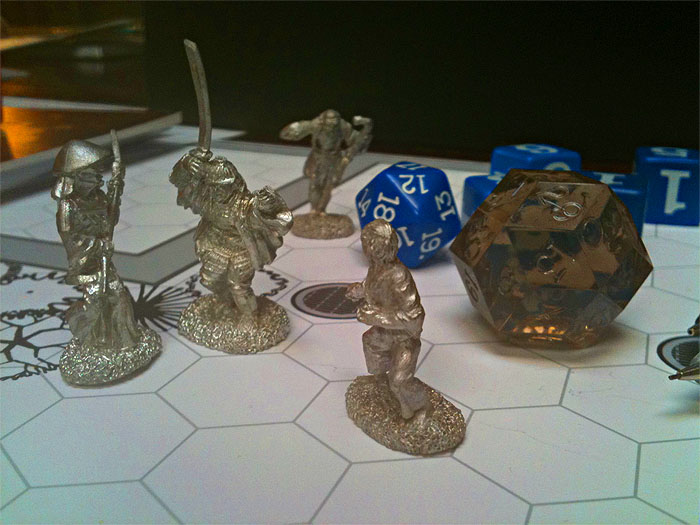
So the other day when my co-consipriator David Welborn and I were testing the Starmasters combat system, the only minis I had handy were some Reaper Minis samurai figures from the mid-to-late 90s designed by Bob Charrette. Coincidentally, Dave's been testing the mechanics (Starmasters shares some basic combat mechanics with The System, The System: Expanded, and my new d30 project Magic, Men, Mutants & Machines) to see how they work to simulate Samurai battles. It was never an intention to specifically include any sort of Samurai genre into the Starmasters setting, it just so happens that the various playtesting is overlapping. That being said, as part of our planned Starmasters playtesting this week, Dave's anxious to see how the system works for some actions specific to Samurai combat (particularly a riposte action.) On the other side of things, I'm now inspired to work in a Samurai pastiche to one of the Starmasters alien races while trying to keep the obvious influnce Japanese rather than Jedi. (After all, everybody knows Star Wars is really just a rip off of Kurosawa's Hidden Fortress.)

Just a reminder, Starmasters doesn't use a d30. I just had it handy from testing the d30 sytem, and felt like including it in the picture because it looked cool.

Monday, November 14, 2011

d30-based RPG Update! (or "Some Old-school Love for the King of Polyhedrals") and "The Nice Price!"

Okay... I know that's a lot to absorb in one blog post title, but I've got a lot to cover, so let's get to it!

First, some old-school love...

So for any of you who read my post on Friday, you know that I mentioned making a great leap forward on my d30-based RPG. I'd been toying around with a form of that mechanic in furtherance of the idea that most pulp heroes are just that... heroes, able to quickly vanquish hirelings and henchmen, and performing most tasks with larger than life artistry and aptitude.

As part of another blog post, I was working on a set of 1E-inspired tables to create "Mutant Humanoids" (hawkmen, crocodile-men, rat-men, et al.) akin to that beloved Saturday-morning cartoon of "savagery, super-science, and sorcery." Now... combine those two thoughts (a d30-based pulp RPG and an OSR approach to that Saturday morning cartoon), and you get "Magic, Men, Mutants & Machines: The d30 RPG of the Mutant Fantasy Future."

And now, the d30-based RPG update...

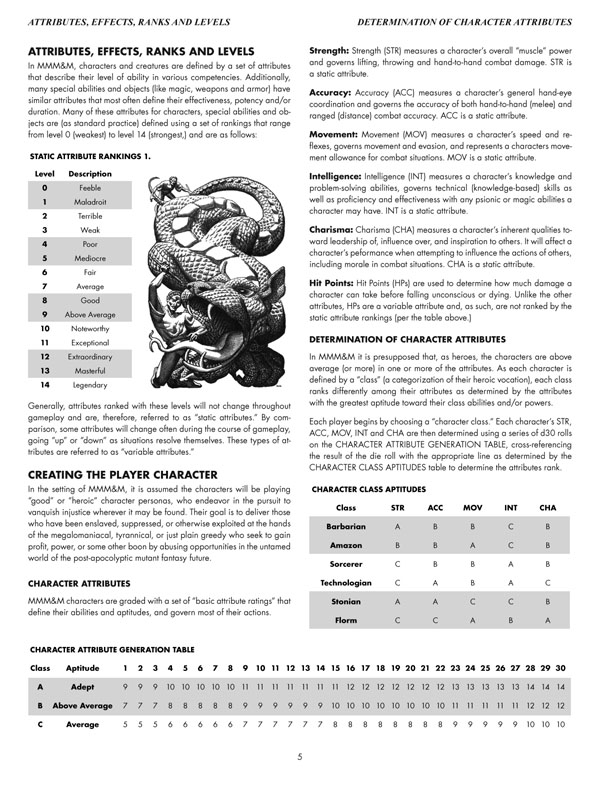
The game is tentatively retitled Magic, Men, Mutants & Machines (or MMM&M for short, or 4M for shorter. FYI, in the book I use MMM&M as it seems much more tongue-in-cheek.)

The introduction and the character sections are done. There are six character classes: 1. barbarians (men only); 2. Amazons (women only); 3. sorcerers/sorceresses (that's a mouthful); 4. technologians (aka "super-scientists); 5. Stonians (muscle-bound rockmen); and 6. Florm (amorphous utilitarian shape-changers.)

At this point, I expect the combat, magic and technology sections to be simplified/modified pickups/reworks of some the Starmasters* and The System: Expanded content, and I'm hoping to have a beta playtest version in a couple of weeks. (I'm still debating whether to include psionics rules, but I'm leaning towards "no" as they seem out of place in this setting for some reason.)

*On a side note, my co-conspirator David Welborn has been leading the charge on playtesting the Starmasters character and combat rules and it seems to be coming along nicely.

And finally, THE NICE PRICE!!!

I've sized the book a bit smaller than letter size so that it can be printed at Ka-Blam!. I'm planning on selling it at just a fraction above the hard costs, which means you should be able to get a 36-40 page rulebook (and that's a fairly dense copy layout; see the image above) with a B&W white cover for $3.50! If you want the color cover version, it will cost you $5 (+S/H in both cases.) Now, when's the last time you bought a printed RPG rulebook for five bucks? Hell, that's what the original Holmes D&D Blue Book (48 pp. + cover) cost when it came out in 1977! (To keep it truly old-school, I'm considering not releasing a PDF version. Thoughts?)

Monday, October 31, 2011

The System Hits 2,000 Downloads (Plus Links to Loads of FREE RPGs!)

I'd like to start off this post by saying "Thank you!" to the 2,000 (and counting) people who, in the last seven months, have downloaded a free copy ofThe System, my universal RPG written originally in the mid-80s. I'd also like to thank Chris's Compendiums of Free Role-Playing Games, John Kim's Free RPGs on the Web, and Rob Lang over at 1KM1KT (1,000 Monkeys, 1,000 Typewriters), all of whom have taken on the vocation of helping rule-makers and home-brewers to get their work out there. Rob even goes above and beyond, working double-duty with the 24 Hour RPG competition, and triple-duty with the Game Chef competition.

So... "What's The System?" you ask?

• • • • • • • • • • • • • • • • • • • • • • • • • • • • •

Some time around seventh or eighth grade (this was around 1980, mind you), I started hearing about this game called Dungeons & Dragons. I knew a couple of guys who played it, but I didn't know much more than that. I remember making the mistake of buying the blue box Expert Set without having played the game or having read the Basic (red) Rulebook. So I saved up another twelve bucks, bought the red box, figured it out (a little anyway), and convinced my younger brother to roll up a character or two. Soon enough we were on our way... to adventure!

The bigger impact on me as a role player came not long after while accompanying my mother on her trip to the hobby shop for cross-stitching supplies. It was there, in a clearance bin, I spied it... a copy of Metagaming's Wizard. It blew me away. It was simple and straightforward. But more importantly, I realized there was more than one RPG out there, and there were other ways of handling character creation and combat.

I moved onto high school, joined the "Warlords" club (our school RPG club) and was exposed to the gamut of games available on the market—simple and fun superhero games, complex medieval games, unique starship combat systems. And the more I discovered, the more interesting it became. Then it hit me... "Why isn't there one RPG that lets you play in any setting or time period." It seemed so natural to me, and I couldn't figure out why no one had done it yet. So I set about creating one.

I'd go to my dad's office every chance I got, sit at that newfangled Wang word processing workstation (you know the one, the big thing with the black screen and green text, the one hooked to that big box on the other table, next to the daisy-wheel printer), and clack-clack-clacked my way through the rules. This early version of “The System” was mostly engineered from the mechanics of other games that made the most sense to me, filling in here and there with some contrivances of my own.

By early 1986, I had a working version of the rules together. I had a few copies printed out, ready to bring them to my gaming group (to see how they played), when a friend showed up at our weekly session with the first couple of GURPS rulebooks. "AAUGH! Somebody beat me to it! (Not that I shouldn't have figured it would happen.)" Staring at those fully-illustrated/typeset/printed GURPS books, I just didn't see the point in continuing with my game.

I went off to college at the end of that summer, got REALLY busy on my schoolwork and lost time to play, and drifted away from the hobby for a while. So my rulebook sat in a folder for years... somewhat forgotten. Until I found them in a box stored in the back of my garage last year, about the same time I discovered the OSR.

Call it nostalgia for those early years, call it the internet “if he can do it, I can do it” attitude, or just call it a waste of virtual space. With a little help from my scanner, an OCR program, and 20 plus years of graphic design experience, I published my original system earlier this year via a downloadable PDF and in a print version through Lulu.com. There was very little content editing (just some clean up for comprehension and a few glaring rule inconsistencies,) and I gave it a decidedly retro bent to the layout and graphics (inspired more by the post white box wave of wargame based RPGs.) So there it is... very raw, but "out there" in the universe nonetheless.

The rules are a little bare-bones and include some very obvious holes (and more typos than I care to mention). Moreover, I feel it to be plagued by the poor writing of a teenager who had yet to discover his voice as a writer, and was doing his best not to plagiarize the writing of the games that "inspired" him.

The new layout, however, is much more user-friendly than the original version produced on that Paleolithic word processor with monospaced daisy-wheel printing and justification forced to the point of illegibility. (It might as well have been chiselled on stone.) And with the addition of a few perfect pieces of vintage public domain clip art, I think it captures the spirit of that early wave of (now “retro”) role playing games. (BTW, there is a much smarter, much stronger, much deeper, and much more streamlined version in the works - The System: Expanded.)

So why did I put it that original (albeit re-published) version out there? Vanity? Legacy? Boredom? Most likely a combination of all three.

I hoped that somebody might find something useful in there, whether it be a game mechanic they'd adapt for their own use, an insight to the home-grown nature of early role-playing games, or (at the risk being committed) a system of mechanics they actually use outright!

So what do those 2,000+ people who've downloaded The System think of it? I have no idea. Though my email address appears with the copyright indicia, I have yet to hear from a single one.

To download a PDF of The System, follow this link to MediaFire.

And don't forget to let me know what you think. I've been in the advertising/design biz for 25 years. I've got thick skin. I can take it.

Thursday, October 20, 2011

Schools of Magic and Game Integration


Yoshitsuya Ichieisai, The Battle of Magic, c. 1860. Triptych, 29" by 14".


Last month, the Unfrozen Caveman Dice-chucker posted about his recent revelations on spell categories—specifically based on the 1978 ed. AD&D Player's Handbook. And as Timrod (a.k.a. the "Dice-chucker") noted in his blog post, "no explanation of the significance of these terms was given in the text of the PHB that I've found and, clearly, none is needed to play the game." Yep. That pretty much sums it up.

I came to a similar place as Timrod myself (in regard to 1st edition) myself way back when (c. 1985), as I set out to design my universal RPG system, The System. The idea of categories/schools of magic seemed ripe for the plucking. Since the goal of the magic system in The System was to create templates for spell creation (as there are no classes of magic user, or list of pre-created spells), the idea of categories/schools of magic was a perfect fit for the concept of spell development as a "formula" (A+B+C=Spell.) As part of that structure, each class of magic has a corresponding "value" that effects the overall complexity (in points) of spells that use those classes; classes like divination and property alteration have much lower values than the likes of transmutation and conjuring/summoning. If the GM deems that the effects of a spell deal with more than one school, both values are added into the overall complexity of the spell (which effects the "draw" on magical energies, as well as increasing the chances of failure during casting.)

The idea of schools as a D&D game mechanic wouldn't really come into it's own until the 2e Complete's Wizards Handbook. It was an offering for wizards to specialize, providing them with the typical "let's make it more complicated so you have to constantly look things up and buy more books" approach to the game. What's underneath all those restrictions, requirements and bonuses, however, is little more than more classes, disguised (or "divided" if you prefer) into schools.

In the original edition of The System, I called them "classes" of magic, but in developing the The System: Expanded (currently in development,) I've abandoned that name for two reasons; first, the term "classes" now refers to the types of spellcaster's within a game setting, developed as part of a Magic Profile Template for the world by the GM (FYI, it's a lot less restricting than than the old-school interpretation of the word implies); and second, the categories of magic are now "schools." Part of the reason I prefer the term "school" to "class," or even "category," is that the term implies that a spellcaster must be educated in using that type of spell.

In The System: Expanded, the schools of magic (prev. classes) will no longer have a static value (per the original edition); instead, the value of each school will be determined by the GM's Magic Profile for the world; this allows for types of magic that may be common within a particular setting to have a much lower value than the rarer types of magic within the setting. Additionally, characters who wish to specialize are not restricted by minimum pre-requisites or racial restrictions like the 2e application of schools. Instead, each school has a guiding set of the character's basic attributes that that are factored into a set of parameters that include, among others, the overall value of the school (i.e. "rarity" per the setting) and a character's aptitude (or inaptitude) based on race/genetics. What this produces is a complexity rating that comes into play regarding every aspect of learning and using those types of spells, from training/education time to chance of success/failure when casting to the spell to the strength/weakness of the spell when cast.

My original list of magic classes in The System was very much a direct interpretation of 1st edition AD&D (per the PHB,) but the new version for The System: Expanded uses a regrouped/compacted system with a couple of new category additions. It also continues to support the mixing/crossing of schools, but these mixed schools may be treated as new or unique schools (with an inherent unique value vs. a cumulative one.) The GM may also create altogether different schools in support of the campaign world. For example, a Far Eastern fantasy setting might use schools broken out by the elements (earth, air, fire, water, wood,) that incorporate many of the types of magic normally considered part of the standard schools (protection, alteration/transmutation, divination, et al.)

Want a sneak preview of the schools of magic from The System: Expanded? Check it out here.