Showing posts with label John D. Batten. Show all posts

Wednesday, December 4, 2013

Really Old Old-School Artist: A. Garth Jones

Every so often, I get lucky and stumble across a really old old-school artist of whom I've never heard. In the case of (Alfred) Garth Jones, I found his name in a minor entry in Modern Book Illustrators and Their Work—which in a few weeks will be officially 100 years old, so... uh... not so modern now as when the book was published. This is a book I've used before as a starting point for seeking out more really old old-school art. Somehow, I've heretofore missed the mention of Garth Jones. It's no wonder, though. Take a look at the book yourself, and you'll see how much great illustration is in there, and how you could research any number of artist represented therein, and not realize you'd missed a couple.

I happened to get the Google ebook result for this book (as opposed to the Archive.org link above) while searching for another illustrator's work (but at this point I couldn't tell you who that was). A short paragraph that begins on page 11 and finishes up on page 12 speaks of illustrations for "Poetry, fantasy, and romance." Jones's name is mentioned alongside the likes of Edmund Dulac, Byam Shaw, and OSR favorite John D. Batten.

Just a couple of biography bullet points and I'll get on to showing some of Jones's work.
Jones starting using his middle name of Garth (Alfred is his given name) to distinguish himself from artists with similar names. (Although I can't find specifics, I would imagine this includes Edward Burne-Jones, Alfred Roller.)

Demand for his work as a book illustrator declined after World War I. (In an age where folks like Virgil Finlay and Hannes Bok were creating new dialects for the evolving language of illustration, I imagine that Jones's style was become a bit unfashionable.)

Compared to the quantity of work Jones produced before World War I, his post-WWI output seems to pale by comparison.

I love the look of the penwork, and how even his pen and ink feels like woodcut.

Friday, February 8, 2013

Really Old Old-School Artist Week Day 5:
Arthur Rackham

And so we come to the conclusion of my week of "Really Old Old-School Artists." Today's artist is Arthur Rackham, and it may be a long time coming from me to old Arthur. I've never really felt the need to feature Rackham in one of these posts because his work is really all over the internet, and has already made its way (along with the likes of John D. Batten) into many an OSR product relying on public domain artwork (e.g., John Stater's Blood & Treasure). The reason I'm delving into such familiar old-old-school artist territory is because most of the Rackham illustrations I'm featuring today have yet to reach the point of oversaturation among us OSR types. The particularly gruesome image below (the first image with the chopped off heads, e.g.) comes from the 1907 edition of The Ingoldsby Legends, a book based on the 19th Century collection of myths, legends, ghost stories and poetry prepared by Richard H. Barham (under the pseudonym of Thomas Ingoldsby of Tappington Manor).


Saturday, December 17, 2011

Another Really Old Old-School Artist

In my Really Old School Artist post from back in November, I discussed the work of John D. Batten and how I discovered Batten's work while trolling Wikimedia Commons to find images for use in the layout of The System. Such is also the case with the work of Willy Pogany.

Hungarian-born Pogany (1882-1955) made his way to America via Paris and London. Being in those locales (Paris and London) at that time (just after the turn of the century), it seems only natural that Art Nouveau found it's influence on Pogany, especially since much of the most interesting work in book publishing at the time was coming out of the Private Press Movement. Another great thing about the Private Press Movement (from the RPGer's perspective) is that much of the subject matter was fantastic in nature, including mythology, fairy and folk tales, and the beginnings of what we now know as fantasy literature. (See my post How the Industrial Revolution Inspired the Original Fantasy Game: A Brief Timeline for a bit more info about this.)

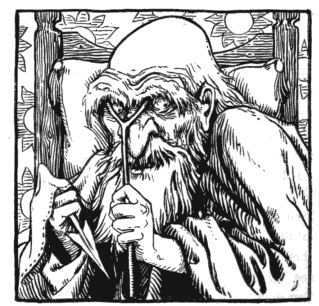
With Pogany, like Batten, the works they created do not feel out-of-place at all in the context of an OSR milieu. In looking at the work below, I'm struck by the resemblance of the work of both Russ Nicholson and Jeff Dee. I'm not claiming the similarities are intentional. As an artist, I know that techniques are techniques, and personal style is something that is truly amalgamated from the artists who've inspired and influenced you. (See my Favorite Artists post for a bit more info on this one.)

So, without further ado, please enjoy these selections from The Children of Odin and The Adventure of Odysseus, both by Padraic Colum (The Macmillan Company), as well one other image that I can't quite source (the one of the beggar that looks like a Russ Nicholson drawing.)


EDITOR'S CORRECTION:
In my original version of this post,
the image at left was credited to
Willy Pogany but, in fact, it was done
by Lorenz Frølich.

Wednesday, November 2, 2011

Really Old Old-School Artist: John D. Batten

Okay, before you read any further, any guesses as to who did this illustration?

It does have that Larry Elmore juno se qua, doesn't it? Well, it's not Larry's.

The old school artist who did this illustration of the fairy tale "The Wooing of Olwen" is John D. Batten. He was born in 1860 and died in 1932. That makes him a REALLY old school artist.

I discovered Batten's work while trolling Wikimedia Commons searching for images for The System earlier this year.

This image is from The Book of Wonder Voyages, a volume by Jason Jacobs, a collection of English, Celtic, Indian, and other European fairy and folk tales.

Just look at this baby... it could have been an OD&D module cover alongside the original 2-color Tomb of Horrors, or the early G Modules.


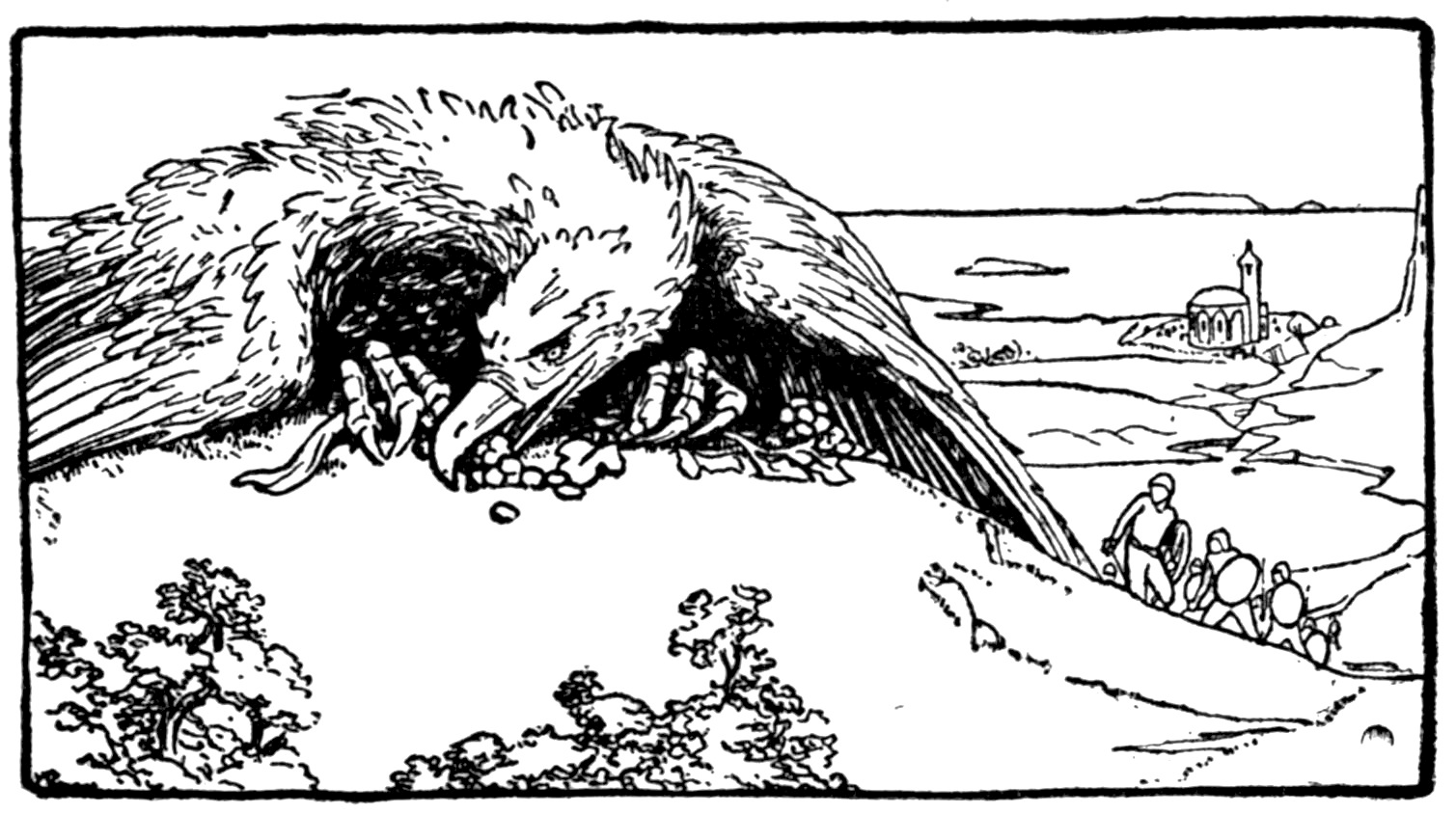
This one is another one from The Book of Wonder Voyages, and looks like it's straight out of the 1e AD&D Monster Manual.

You can probably see why I relied so heavily on so many images from Batten when I put together The System. It was a way of inexpensively achieving an old-school illustration look by going really old school.