Any of you who played Jeff Dee & Jack Herman's Villains & Vigilantes "back in the day" probably have some of the same fond recollections of the game that I do. First, the FGU ads for V&V in Dragon magazine were all it took for me to say to myself, "I want to own that game." Second, I thought it was pretty decent of FGU to include the game master's screen in the box (Revised Edition, 1982) rather than try to sucker me out of another 5 or 10 bucks later (even if it was in B&W white on a pretty cheap uncoated card stock.) And third, it included the "Laws of the Land," (section 5.5 A), a pretty standard criminal code that helped a high schooler wrap his head around concepts like "criminally negligent homicide" and the differences between first- and second-degree kidnapping.
So what has me reminiscing about learning criminal codes 5+ years before Law & Order started its 20-year run? I have jury duty today. I don't know what it is about me, but I seem to be a magnet for jury duty. No sooner is my ineligibility period over when my next jury summons arrives in the mail. C'mon, man... FUNK DAT! Hopefully I won't have to spend too much time in voir dire, which should leave me free most of the morning to concentrate on additional engines, tables, etc. for my d30 DM Companion.
Oh, and in the picture above (a scan of one of my old character sheets that's been in my V&V box since 1985/6)... I don't remember if the character's name was supposed to be an intentional pun, or if it was just a typo.
Wednesday, December 7, 2011
Tuesday, December 6, 2011
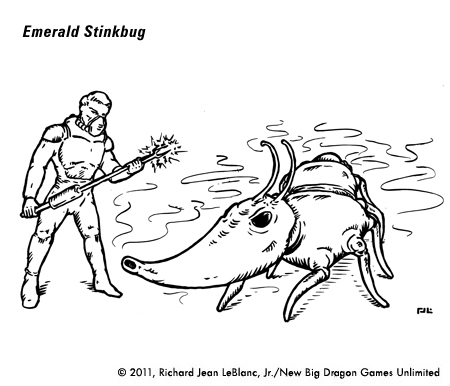
Illustration of the Week: Emerald Stinkbug (Starmasters)
Another Starmasters creature.Image ©2011, Richard Jean LeBlanc, Jr./New Big Dragon Games Unlimited. The reproduction or re-purposing of these images is strictly forbidden except by direct permission by the copyright holder. These images are NOT CREATIVE COMMONS!
Monday, December 5, 2011
New Magic Item: Dagger of Dark Revelation
From the upcoming module
OE1 The Mysterious Mist of Foxpond,
an introductory OE/BX OSR adventure
for characters level 1-3.
This ornate dagger does a base of 1d4 damage, but provides damage and hit modifiers based on alignment: chaotic/+2, neutral/±0, lawful/-2. Additionally, the longer a neutral or lawful character possesses the dagger, there is a chance their alignment will change (to chaotic) without them being aware. Every hour a character possesses the knife, that character (regardless of alignment) must make a saving throw (vs. spells) or be unable to resist the urge to use the dagger to kill the closest living sentient being (friend, enemy or otherwise.)
OE1 The Mysterious Mist of Foxpond,
an introductory OE/BX OSR adventure
for characters level 1-3.
This ornate dagger does a base of 1d4 damage, but provides damage and hit modifiers based on alignment: chaotic/+2, neutral/±0, lawful/-2. Additionally, the longer a neutral or lawful character possesses the dagger, there is a chance their alignment will change (to chaotic) without them being aware. Every hour a character possesses the knife, that character (regardless of alignment) must make a saving throw (vs. spells) or be unable to resist the urge to use the dagger to kill the closest living sentient being (friend, enemy or otherwise.)
Sunday, December 4, 2011
d30 Companion Update
It seems I'm well underway toward having the d30 DM companion ready in the next couple of weeks! This is no mere compilation of a bunch of numbered (1-30) lists of conditional encounters. These are, in most cases, either 1) true "engines" for creating as much variety as possible in as few rolls as possible, or 2) d30-based mechanics to SIMPLIFY AND SUPPORT the role of the DM/GM.
So far, here's what's prepped. (BTW, each of the following takes no more than 1 page!):
NPC GENERATORS
- Classed NPC Generator: (810,000 unique NPCs in 4 x d30 rolls)
- Non-classed NPC Generator: (810,000 unique NPCs in 4 x d30 rolls)
- NPC Attribute Generator: (slot based, for classed and non-classed NPCs)
TREASURE GENERATORS
- Gem & Gem-centric Jewelry: (27,000 unique items in 3 x d30 rolls, including g.p. value)
- Elven & Dwarven Jewelry: (900 unique items in 2 x d30 rolls, including g.p. value)
- Magic Weapons, Armor & Protective Items: (810,000 unique items in 4 x d30 rolls)
ENCOUNTER GENERATORS
So far, this section only includes outdoor encounters with humanoid remains (900) and markers and signs (30). But those two (combined) take up less than half of a page!
TARGET DATE?
I'm hoping to have the entire book ready for press by December 16th. Planning on a printed booklet of 24 pages plus cover (8x10.5 - and yes, printed; not PDF) that will sell for an introductory price of around $3. That's less than the cost of most PDFs! (Look... I'm old-school, like an old-fool. I love my iPad, but prefer paper in my hands at the gaming table.)
Next update to come next weekend.
So far, here's what's prepped. (BTW, each of the following takes no more than 1 page!):
NPC GENERATORS
- Classed NPC Generator: (810,000 unique NPCs in 4 x d30 rolls)
- Non-classed NPC Generator: (810,000 unique NPCs in 4 x d30 rolls)
- NPC Attribute Generator: (slot based, for classed and non-classed NPCs)
TREASURE GENERATORS
- Gem & Gem-centric Jewelry: (27,000 unique items in 3 x d30 rolls, including g.p. value)
- Elven & Dwarven Jewelry: (900 unique items in 2 x d30 rolls, including g.p. value)
- Magic Weapons, Armor & Protective Items: (810,000 unique items in 4 x d30 rolls)
ENCOUNTER GENERATORS
So far, this section only includes outdoor encounters with humanoid remains (900) and markers and signs (30). But those two (combined) take up less than half of a page!
TARGET DATE?
I'm hoping to have the entire book ready for press by December 16th. Planning on a printed booklet of 24 pages plus cover (8x10.5 - and yes, printed; not PDF) that will sell for an introductory price of around $3. That's less than the cost of most PDFs! (Look... I'm old-school, like an old-fool. I love my iPad, but prefer paper in my hands at the gaming table.)
Next update to come next weekend.
Saturday, December 3, 2011
Combat Mantra of the Day: "Resolution, Not Simulation" (Starmasters Playtest Update)
Ran my first Skype combat playtest last night with my co-conspirator Dave Welborn. I have to say I was pleasantly surprised, both the refinements in the system AND the moderately seamless play via that fancy interweb thang. Unlike the more nebulous "loose action" (role-playing intensive) aspects of gaming, Starmasters combat benefits greatly from being able to visually track 1) movement, facing and distance on a hex map, and 2) initiative/action turns (moderated in "phases," per the image at the top of this post.) Screen sharing worked well enough, though I was on the sending end; Dave would have probably preferred a bit more resolution in the image.
The thing that has kept us grounded as we've tested is our mantra for Starmasters combat, "Resolution, not simulation." We sometimes, in our fervor for trying to resolve every issue that comes up, focus on creating added mechanics rather than simplifying/generalizing the ones we already do have. We have, so far, been pretty good about keeping an old-school approach in creating mechanics the GM can interpret based on our examples, in lieu of creating volumes of rules to answer every situation. I can see how the AC system of D&D (resolution) was a simpler alternative to Chainmails "rules for medieval miniatures (which began more, relatively, as a simulation.)
Last night's playtest took place in a more complex "battlefield" than last week. This time around, we used a building interior with more walls and doors and passage areas, compared to the more open/landscaped battle area from the last playtest. It seemed to make it a more offensive game, where characters were more intent on getting shots off and positioning themselves strategically for cover, rather than relying on defensive moves (like dodging and diving.)
We did seem to resolve the off-target issue for "area of effect" weapons. We used a mechanic similar to Starmasters' "range indexing" (in which a character's ACC affects his overall range with a fired weapon, scaling distance penalties to the character's ACC); Dave had already come up with this mechanic as of last playtest, but this round proved it in practice.
We need to refine the added mechanic for fumbling/stumbling (if a character tries to do too much in one phase.) The mechanic is good; the method for determining odds needs to be tweaked. Too many characters dropped their weapons too often.
Next up... moving from the "every man for himself" free-for-all, and moving to a "team vs. creature" mode. The plan is to arm and armor the team heavily, but put them up against some nasty alien creatures. I can't wait!!!
The thing that has kept us grounded as we've tested is our mantra for Starmasters combat, "Resolution, not simulation." We sometimes, in our fervor for trying to resolve every issue that comes up, focus on creating added mechanics rather than simplifying/generalizing the ones we already do have. We have, so far, been pretty good about keeping an old-school approach in creating mechanics the GM can interpret based on our examples, in lieu of creating volumes of rules to answer every situation. I can see how the AC system of D&D (resolution) was a simpler alternative to Chainmails "rules for medieval miniatures (which began more, relatively, as a simulation.)
Last night's playtest took place in a more complex "battlefield" than last week. This time around, we used a building interior with more walls and doors and passage areas, compared to the more open/landscaped battle area from the last playtest. It seemed to make it a more offensive game, where characters were more intent on getting shots off and positioning themselves strategically for cover, rather than relying on defensive moves (like dodging and diving.)
We did seem to resolve the off-target issue for "area of effect" weapons. We used a mechanic similar to Starmasters' "range indexing" (in which a character's ACC affects his overall range with a fired weapon, scaling distance penalties to the character's ACC); Dave had already come up with this mechanic as of last playtest, but this round proved it in practice.
We need to refine the added mechanic for fumbling/stumbling (if a character tries to do too much in one phase.) The mechanic is good; the method for determining odds needs to be tweaked. Too many characters dropped their weapons too often.
Next up... moving from the "every man for himself" free-for-all, and moving to a "team vs. creature" mode. The plan is to arm and armor the team heavily, but put them up against some nasty alien creatures. I can't wait!!!
Friday, December 2, 2011
27,000 Different Magic Items in 3 Die Rolls!
This week's d30 Feature allows you to generate 27,000 different magic items in only 3 die rolls! (The die does, of course, have to be a d30.)
I've tried to structure the charting to provide as much theme development as possible, while still trying to offer some variety. I didn't want to just randomly assign different properties so that you have a schizophrenic magic item whose origins would be hard to ascertain. So two disclaimers: 1) the items are limited (in these charts) to weapons and armor, and 2) the chart is a little open to interpretation (which I believe these kinds of charts should be.) As an example to the point of interpretation above, during roll 2 (in which the type is chosen), the categories are a bit general (e.g., "humanoid" and "fire-breathers.") My suggestion is, once a GM has discerned all the properties, he/she should feel free to refine them based on the other properties.
Here's a couple of random sets of rolls examples of the vast variety possible:
ROLL SET A:
Roll 1 = 26: item type = scale mail
Roll 2 = 12: basic properties = +2 vs. cold-using/dwelling
Roll 3 = 5: additional properties = +2 save vs. paralysis
You can see how that item as a nice overall theme going for it. And completely random. Now, just fill it in a with some sort of appropriate name (like Draconian Armor of Warmth) and you've got yourself a moderately unique magic item.
ROLL SET B:
Roll 1 = 3: item type = (head) band
Roll 2 = 26: basic properties = +3 vs. humanoids*
Roll 3 = 15: additional properties = +1 WIS
First off, I swear, the headband that provides +1 WIS was totally random! Now, the +3 vs. (all) humanoids is a little strong, so let's go with just orcs, and customize a bit so the WIS bonus is only given to clerics... Voilà! An clerical band of protection from orcs.
ROLL SET C:
NOTE: This set produced the following rolls: 17, 13, 18. I think that because these numbers were so close together, it becomes a strong test of whether these tables work or not. So let's take a look, shall we?
Roll 1 = 17: item type = small shield
Roll 2 = 13: basic properties = +2 vs. giant class
Roll 3 = 18: additional properties = detect type, 100'
I'm seeing this as a Dwarven shield of giant protection.
Now, I'm not saying all of the results will make complete sense. For example, if Roll Set C (above) had produced a 3rd roll of 14, the shield would have granted it's bearer a +1 INT bonus. At first glance, I'm not sure if that makes complete sense or not. We need to put those properties in the right context... so... given that the shield is small, and INT is a prime req. for thieves, which is a typical class for halflings, maybe under those circumstances it becomes a halfling shield of giant protection.
Okay. I'm thinking this works pretty well.
To download a free PDF of today's chart from MediaFire, click here.
I've tried to structure the charting to provide as much theme development as possible, while still trying to offer some variety. I didn't want to just randomly assign different properties so that you have a schizophrenic magic item whose origins would be hard to ascertain. So two disclaimers: 1) the items are limited (in these charts) to weapons and armor, and 2) the chart is a little open to interpretation (which I believe these kinds of charts should be.) As an example to the point of interpretation above, during roll 2 (in which the type is chosen), the categories are a bit general (e.g., "humanoid" and "fire-breathers.") My suggestion is, once a GM has discerned all the properties, he/she should feel free to refine them based on the other properties.
Here's a couple of random sets of rolls examples of the vast variety possible:
ROLL SET A:
Roll 1 = 26: item type = scale mail
Roll 2 = 12: basic properties = +2 vs. cold-using/dwelling
Roll 3 = 5: additional properties = +2 save vs. paralysis
You can see how that item as a nice overall theme going for it. And completely random. Now, just fill it in a with some sort of appropriate name (like Draconian Armor of Warmth) and you've got yourself a moderately unique magic item.
ROLL SET B:
Roll 1 = 3: item type = (head) band
Roll 2 = 26: basic properties = +3 vs. humanoids*
Roll 3 = 15: additional properties = +1 WIS
First off, I swear, the headband that provides +1 WIS was totally random! Now, the +3 vs. (all) humanoids is a little strong, so let's go with just orcs, and customize a bit so the WIS bonus is only given to clerics... Voilà! An clerical band of protection from orcs.
ROLL SET C:
NOTE: This set produced the following rolls: 17, 13, 18. I think that because these numbers were so close together, it becomes a strong test of whether these tables work or not. So let's take a look, shall we?
Roll 1 = 17: item type = small shield
Roll 2 = 13: basic properties = +2 vs. giant class
Roll 3 = 18: additional properties = detect type, 100'
I'm seeing this as a Dwarven shield of giant protection.
Now, I'm not saying all of the results will make complete sense. For example, if Roll Set C (above) had produced a 3rd roll of 14, the shield would have granted it's bearer a +1 INT bonus. At first glance, I'm not sure if that makes complete sense or not. We need to put those properties in the right context... so... given that the shield is small, and INT is a prime req. for thieves, which is a typical class for halflings, maybe under those circumstances it becomes a halfling shield of giant protection.
Okay. I'm thinking this works pretty well.
To download a free PDF of today's chart from MediaFire, click here.
Thursday, December 1, 2011
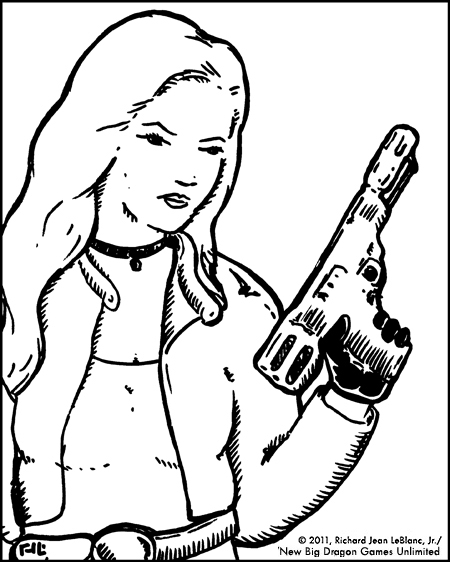
Starmaster: Captain Crane Simpson, Squad Leader, Investigation Team, Code Alpha
Like most humans, Crane had no memory of her first birthday. Nor her second. Nor her third. Neither did she have any recollection of Terran Unification Day, though she was five at the time, and her grandmother made 1,000 cookies in honor of The One Thousand, and the entire floor of their domo tower smelled like perlant chips for a week. These are the kinds of things that most humans remember. But Crane wasn't most humans.
Crane's first memory, as clear as any crisp deciduous morning, was of the porcelain fingernail at the tip her left index finger stroking a thin line up that warm shaft, the sweet smell of the afterflux seeping from the chamber and up to her thin, oval nostrils, and crawling it's way up her nasal passages and burring itself deep into her hippocampus like a hungered Thuzzendahg. After all, it's not every day a girl fires her first Stermer blaster.
She'd come by it honestly. It had been her father's before he died liberating the Ekerats on what is now New Callisto. And it had been his father's before he granted it to Darmon Jr., Crane's Father, on the day he enlisted in the Terran Exploration Corps. It was Crane's mother's wish that Crane never find it but, as these things go, fate trumps desire every time.
It was fate that brought that blaster home with the remains of Crane's father and put it in the hands of Crane's mother, Ophelia. And it was fate that brought Crane to live with her grandmother when Ophelia died from a blood parasite. And it was fate that drove Crane deep into the far corner of her grandmother's closet where she found the burled Fellwood box, engraved with her great, great, grandfather's initials, and heard the voice of destiny calling to her from inside.
Crane's first memory, as clear as any crisp deciduous morning, was of the porcelain fingernail at the tip her left index finger stroking a thin line up that warm shaft, the sweet smell of the afterflux seeping from the chamber and up to her thin, oval nostrils, and crawling it's way up her nasal passages and burring itself deep into her hippocampus like a hungered Thuzzendahg. After all, it's not every day a girl fires her first Stermer blaster.
She'd come by it honestly. It had been her father's before he died liberating the Ekerats on what is now New Callisto. And it had been his father's before he granted it to Darmon Jr., Crane's Father, on the day he enlisted in the Terran Exploration Corps. It was Crane's mother's wish that Crane never find it but, as these things go, fate trumps desire every time.
It was fate that brought that blaster home with the remains of Crane's father and put it in the hands of Crane's mother, Ophelia. And it was fate that brought Crane to live with her grandmother when Ophelia died from a blood parasite. And it was fate that drove Crane deep into the far corner of her grandmother's closet where she found the burled Fellwood box, engraved with her great, great, grandfather's initials, and heard the voice of destiny calling to her from inside.
Subscribe to:
Posts (Atom)