Showing posts with label becmi. Show all posts

Friday, September 26, 2025

Defining Full Telepathy vs. Limited Telepathy

I've been working on a pretty significant new d30-related book—well, really books... plural (more to come in future posts). And I realized I was assigning creatures as having Telepathy or Limited Telepathy, without really knowing what that actually means. For example, many AD&D Monster Manual creatures are noted as having "limited telepathy" but never really describe what that means—like the lammasu... "Lammasu communicate in their own tongue, the language of lawful good, and through a limited form of telepathy."

Okay... so what are the limits?

They got better about this in 2e, but I set out to define Full Telepathy vs. Limited Telepathy (particularly for how it would be treated in my House Rules). So here goes...

FULL TELEPATHY

Full Telepathy supports full and clear mental communication with other creatures with very few restrictions.

  • Usable at will. Full Telepathy, as an inherent ability (vs. a spell-like ability) is usable at will.
  • Sentience is required. In order for the communication to take place, the target creature must have an intelligence of at least 1.
  • No common language is needed. The telepath and the target need not share a common language.
  • Two-way communication is supported. Full telepathy is always two-way, allowing for a conversation.
  • A longer range is achievable. The standard range for Full Telepathy is 90'.
  • Sighting isn't required. Full Telepathy allows for the telepath to “sense” the presence of other minds within range and target them directly.
  • Communication is possible to select multiple creatures at once. The telepath can communicate with as many eligilbe targets within the range as they choose, but only one message may conveyed at a time (that is, the telepath may not conduct multiple conversations at once, unless otherwise described for that individual telepath). 
  • Communication is quicker than normal speech. Full telepathy allows for the conveyance of abstract concepts beyond simple words, allowing for much quicker communication (particularly over the linear limitations of speaking and the rudimentary nature of Limited Telepathy).
  • Concentration is not required. The telepath is usually able to perform other physical actions (e.g., combat, use of a breath weapon) while using Full Telepathy. Spellcasting, however, is typically prohibited while communicating telepathically (given the verbal component required). Full Telepath does not, however, hinder the use of spell-like abilities (that don’t require the verbal components of spellcasting).

LIMITED TELEPATHY

Limited Telepathy has any number of specific restrictions that kept it from being as versatile as Full Telepathy. The following limitations are common, but all of them need not apply, nor are they limited to the ones noted below.

  • Usable at only certain times or under certain conditions: Though commonly usable at will, the use of Limited Telepath may have limitations that constrain when, where, and how often it may be used (e.g., in the Astral Plane, 3×/day, for 10 minutes every hour, etc.)
  • Higher Intelligence Requirement: Like Full Telepathy, order for the Limited Telepathy to take place, the target creature must have an intelligence of at least 1. However, a higher Intelligence (e.g., 3 or greater) may be required.
  • Shared language required: The telepathy functions only if both creatures share a common language. This may be the most common limitation.
  • One-way communication: Under this circumstance, the telepath is able to either: a) send thoughts, emotions, or images to another creature, but not receive them in return; or b) understand the meaning of a speaker’s words, even if the telepath doesn’t speak the same language.
  • Limited to simple concepts: Some forms of Limited Telepathy are limited to conveying only simple ideas, feelings, or images rather than complex thoughts or conversations.
  • Species-specific: In such cases, the telepathy only works between members of the same species.
  • Limited range: The distance over which the telepathy operates may be significantly shorter (e.g., as little as 10').
  • Sighting required: The telepath may need to be able to see the target in order to communicate with (or, at a minimum, to establish the connection with) them.
  • Limited recipients: Typically, Limited Telepathy is confined to conversation with a single creature at a time.
  • Concentration required: If concentration is required, the telepath may undertake no other physical actions at the same time, or the telepathic connection will be lost.
Unless otherwise stated for a creature entry that includes Limited Telepathy, assume that a noted limitation restricts only that condition, and otherwise functions as Full Telepathy (e.g., "Limited Telepathy: shared language required." would function as Full Telepathy, except the telepath and target(s) must share a language.

Thursday, July 14, 2022

Coming Soon... In Alley & Shadow (Dragon Horde Zine, Volume II, Issue 2)


This has been in the works for a while, and we're in the final round of edits and tweaks. 

Here's a look at the goodness inside...

CHARACTER INFORMATION 
  • New Character Class: Spy
  • New Character Class: Varlet 
  • d30 Alias Characteristics 
  • New Magic-user Spells: Spells of Stealth & Subterfuge
  • New Cleric Spells: Spells of Truth & Revelation
  • House Rule: Thieves’ Ability to Find/Disarm Traps
  • House Rule: Setting & Resetting Traps
EQUIPMENT
  • Spy Equipment
  • Chains, Keys, Locks, and Manacles
THE ADVENTURE
  • A Detailed Look at Locks
  • Clandestine Communication: A Guide to Ciphers, Symbols, Codes, and Cants
DM INFORMATION
  • A Basic Guide to Thieves’ Guilds
  • d30 Thieves’ Guild Names
  • d30 Thieves’ Guild Events
  • Assassins’ Fees
  • Spy Missions 
  • Crime & Punishment
  • Building Better Bandit Encounters 48
  • d30 Bandit Lair Locations
NEW ADVENTURE
  • The Tomb of 13 Thieves: An adventure for 5–7 characters of 3rd–5th level
MAGIC ITEMS
  • Designed for Deception
NEW PETTY GODS
  • Patrons of Trickery & Treachery

Thursday, June 16, 2022

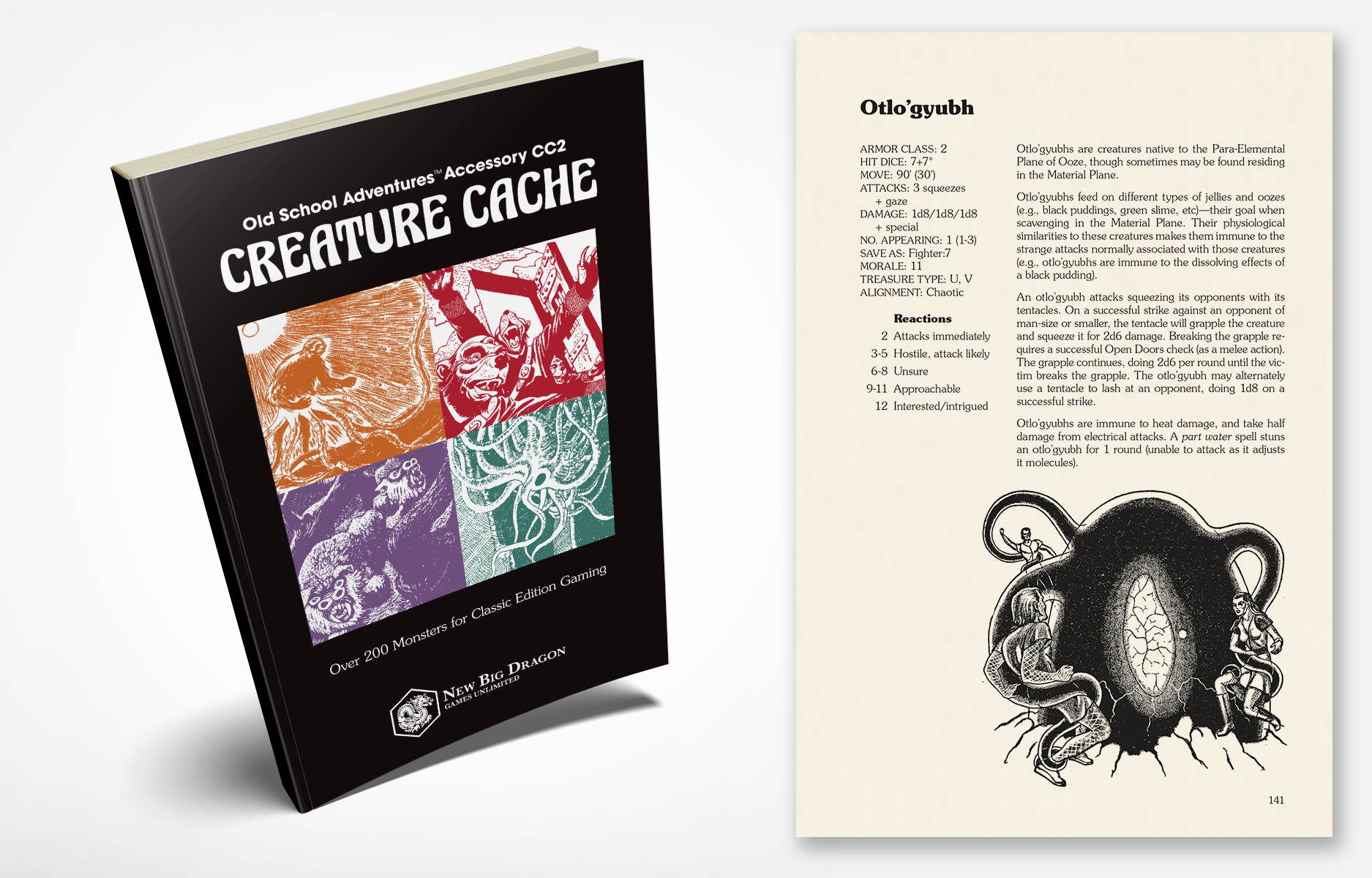
Old School Adventures™ Accessory CC2: Creature Cache Now Available

200 new monsters based on PD pulp images statted for classic editions (OSE, B/X, BECMI, LL, etc.). Available in PDF from DriveThruRPG, and in hardback and paperback from Lulu.com. The hardback has white interior pages, and the paperback has a cream interior (nodding to the books pulp roots). Includes new animal-related spells and new psionic abilities for Basic Psionics. (236 pages)


Hardback has white interior pages.

Paperback has cream interior pages.


Saturday, September 25, 2021

Dungeon Master Information: Crime & Punishment

 From the upcoming release, Dragon Horde Zine, Volume 2, Issue 2: In Alley & Shadow.


Arrest & Trial

In a manorial system, the keeping of the peace generally falls under the jurisdiction of the sheriff, who is also responsible for collecting revenues, fines, and rents, executing writs, and guarding prisoners. However, the onus of law enforcement is placed upon the citizens, who are relied upon to maintain order and apprehend criminals.

The status and position of different groups affects their protections by law. For example, a noble and a peasant committing the same crime may be afforded different types of trials.

The major forms of trial include:

Trial by Exculpatory Oath and Compurgation. All but the most serious crimes are dealth with this way. The defendant establishes their innocence or non-liability by taking an oath and by getting a required number of persons (typically 12) to swear they believed the defendant’s oath. It is the jury’s responsibility to collect evidence in order to make the determination of guilt and assign punishment (if found guilty).

Trail by Ordeal. This is usually reserved for more serious crimes, peasants, persons of bad reputation, or those caught with stolen goods. Guilt or innocence is determined by subjecting the accused to a painful, (and often quite dangerous) experience. Many accused choose to admit guilt (even if they are innocent) in order to receive a lesser punishment.

Trial by Combat. When accusations are made in the absence of witnesses or a confession, the two parties at odds settle the dispute with single combat. The winner of the fight is proclaimed to be right.

Outlawry

Persons who are accused of particularly heinous crimes (e.g., homicide) or defy the laws of the realm (e.g., ignoring a summons to court, fleeing insteading of appearing to plead when charged with a crime, commiting treason, participating in rebellion), may be declared as an “outlaw” by a Writ of Outlawry. This writ places them outside the protection of the law, withdraws any legal protection for them, and legally empowers anyone to persecute or kill them. Furthermore, all of the outlaw’s possessions are seized by the courts.

Outlawry can be reversed in one of two ways:

Plead Error. The outlaw appears in court and declares they were erroniously declared an outlaw. 

Plead Pardon. The outlaw must first surrender to authorities, then present their plea to the court. If the outlawry is reversed or pardoned, the seized possessions will be returned (if possible).

Punishment

Most communities believe that the best way to keep order is ensure that people fear the punishment given when a crime is committed. Therefore, many punishments may seem harsh, especially for lesser crimes. 

Trials by ordeal are their own punishment. The most common forms include:

Ordeal by Poison. The accused is given a posionous substance to eat or drink. If they survive, they are innocent.

Ordeal by Fire. The accused is required to walk nine paces in bare feet on nine red-hot plowshares or to walk nine paces while holding red-hot iron. In most cases, the accused is the bandaged for three days, then found guilty if the wounds fester or not guilty if they have healed. In some cases, there must be no sign at all of injury in order to be found not guilty.

Ordeal by Boiling Water. The accused plunges their hand in a kettle or pot of boiling water (sometimes oil or lead is used instead) to retrieve a stone. The assessment of the injury (i.e., the consequences of divine intervention or lack of it) determines guilt.

Ordeal by Cold Water. The accused has their hands and feet tied together, and is thrown into a body of water (or pit filled with water blessed by a priest). If the accused floats, the water “rejects” them so they are found guilty. The innocent sink.

The table below lists common crimes and their common punishment, though the specific punishment for a crime may change based on the standards of the community.


CrimeDefinitionPunishment
Mayhemintentional maiming of another personexecution
Homicidethe deliberate killing of one person by anotherhanging (men) or burning at the stake (women)
Murdrumthe killing of a person in a secret mannerheavy fine on the community where the secret killing occurred
Burglaryentering property without consenthumiliation or torture
Robberytheft by forcehanging (men) or burning at the stake (women)
Petty Thefttheft with value up to 5spvaries, includes: fine of 10× value of stolen goods
Thefttheft with value from 5sp to 1gppublic beating or flogging, or mutilation
Frauddeceptive business practicescomparable to theft, based on number of infractions and total value
Full Theiverytheft with value of 1gp or morehanging from a tree or a gallows, or by banishment from the city and its environs
Possessionreceipt of stolen propertymutilation or execution
Poachingthe illegal hunting or capturing of wild animalshanging, castration, blinding, or being sewn into a deer skin and then hunted down by ferocious dogs
Usurylending money at unreasonably high rates of interestfines
Briberythe giving or offering of a bribefines
Forgerymaking, altering, use, or possession of a false writing to commit fraudnot generally regarded as a crime unless related to government (e.g., forging of a king's seal) in which case it may be treated as treason
Suppositioncreation of false documents, texts, books, and artifacts public humiliation
Coin Clippingshaving off a small portion of a precious metal coin for profitmutilation or execution
Vandalismdeliberate destruction of or damage to propertycomparable to theft, based on number of infractions and total value
Riotingoffense against public order involving three or more peoplemutilation or execution
Kidnappingabducting someone and holding them captivepublic torture and/or execution
Breach of the Peacedisorderly conduct, public drunkenness, common scoldfines or public humiliation (stocks or pillory)
Indecent Exposurepurposeful display of one's genitals in publicmutilation
Gossipingspreading rumorspublic humiliation (scold's bridle)
Cheatingacting dishonestly or unfairly, especially in gamespublic humiliation (stocks or pillory)
Adulterysexual intercourse between married person and non-spousepublic humiliation, mutilation (breast ripper), ordeal by fire, or drowning
Prostitutionengaging in sexual activity with someone for paymentpublic humiliation
Slanderfalse spoken statement damaging to one's reputationtongue cut out
Blasphemyspeaking sacrilegiously about sacred thingstorture (pear of anguish)
Defying the Churchacting in opposition to religious beliefs or ordersheretic's fork
Heresyholding beliefs contrary to religious doctrineordeal by fire, ordeal by hot water, or execution (burning at the stake)
Witchcraftthe practice of dark/forbidden magicordeal by cold water
Repeat Offensesmultiple offenses of a specific crimebeating, maiming, or hanging
Attacking Officialsmayhem against officials of church or stateexecution
Protestingthe public expression of disapproval of governmentexecution
Treasonbetraying one's countrybeheading (nobles) or drawing& quartering (commoners)
Rebellionviolent or open resistanceto government or rulerexecution